Everyone says that but I've had the opposite experience, possibly due to my location (near Orchard Rd). Can easily pay $15 to essentially go around the corner.
I love walking - checking distance tracking on my phone, I walked over 20km in a day a couple of weeks ago. But when it's hot in Singapore, the distances I don't want to walk can become crazy-short at times.
I'm hesitating to judge someone taking a ride-share around the corner. Among many other reasons, I can imagine scenarios where someone would think it worth paying to not arrive a sweaty mess.
I’ve been travelling to singapore for the last 15 years, my gut view is cabs are far more expensive today than they were 10 years ago even after adjusting for inflation. Maybe it’s just incorrect memories - rates don’t seem to have increased that much.
I walk 99% of the time. By around the corner, I mean a 10 - 20 min walk (5 min drive in good traffic), which will easily get you drenched in sweat depending on the weather. If I'm headed to a dinner or gathering that requires a bit of dressing up (shirt and trousers), walking isn't really an option.
My next trip to singapore is the end of next week. I’m staying a mile from the office, Apple predicts it’s 89% at 0730 but will drop to 75% during the day, and back upto 80% after dinner.
When was this? I lived in a condo at walking distance from Orchard station for a couple of years and never had the feeling that I was paying more for the cab. I also lived in other less affluent areas so I had a good idea about how much it should cost.
Does anyone know what they're smoking in that big pipe at about 25:15 into the video?
Imagine showing up in a remote village as an anthropologist and after a few hours the first thing the villagers ask you to partake in is the equivalent of a huge bong hit. And you don't want to offend anyone by refusing...
Actually your comment reminds me of this guy who travels to Vanuatu to try really strong kava. The village chief invites him to drink multiple bowls, which he can't refuse: https://www.youtube.com/watch?v=-BtP_B4TBWs
...basically this is the "take a few near-pre-contact villagers around the U.S. and show them how cool the rest of the world is" that the article talks about.
There was another show (might have been "Going Tribal(?)") which did the reverse, where a "modern man" tried to integrate into daily life tribal life, eg: setting fish traps, mauling taro root, trying not to scare away rabbits while hunting with bows and slings, etc.
Probably tobacco. The article mentions it was introduced to PNG in the last few hundred years, and the plant made its way into the highland tribes despite limited travel and trade.
This was an incredible video, and I feel so many complex emotions after watching it. I wonder where everyone in that video is now.
Sounds like there's some controversy about this video though. There was some accusations that it was staged, and / or that this was NOT the first contact this tribe had.
That was fascinating and endearing. I wonder whether anyone there is still alive, and how profound/impactful that meeting was on those and the generations that followed. Thanks for sharing
I am realy excited for the Findings on these missions. Altough I am still missing an Enceladus mission because enceladus is among the most fascinating ocean worlds.
Maybe I missed it but they didn't delve much into the TAM.
"Half of all flights in the world are under 2 hours." Then they give examples of Fjord-town hopping in Norway, or Island hopping in Hawaii, which seem very niche.
Will they be able to compete in any of the busiest routes? Could it take me Melbourne-Sydney in 1 - 2 hours for < $100? I'd sacrifice some time and $ for an eco-friendly option, but obviously there's a limit.
Batteries are rapidly improving (on many metrics, but the relevant one here is increasing in energy density).
The range is apparently 125 miles electric, and 500 miles as a hybrid. That's not enough for Melbourne Sydney. Give it a couple doubling-times though (5 years total?) and it will be.
Meanwhile aircraft take forever to develop and there should be enough of a market in shorter hall flights to occupy a scaling company in the meantime anyways.
Batteries aren't rapidly improving. Every single battery that has proposed higher energy density also has downsides in max discharge current. We may get at best like 10% improvement over what it is today.
If you are consuming X watts per cell, then each cell will drain by the same amount of current regardless of whether the cells are in series or parallel (or more likely a combination of the two).
This is supposed to be able to handle "up to" 2-hour flights, and (for jets at least) takeoff power is about 3x cruise power, so about 1.5 watts per watt-hour of battery, or a 1.5C peak discharge rate. What chemistries are you thinking of that cannot handle this?
The full power system for a prop looks like this: you have a battery of a specific voltage, which then runs a motor, which then runs a gearbox, which then turns a prop.
The motor and the gearbox can be considered as one unit - an electric motor has two factors, KV(RPM/volt) and KT(torque/amp). The higher the KV, the lower the KT. A high KV motor spins fast, but draws a lot of current for the same torque - putting it through a reduction gearbox turns it into a low KV, high KT motor. Naturally, low KV motors or (low KV setups) are more efficient because they draw less current for a given torque, and the heating power loss varies with current^2.
The prop needs to spin at certain RPM for max aerodynamic efficiency. Given the slider for motor/gearbox selection between high KV/low KT and the opposites, you generally want to have as high voltage as possible, so that you can run a low KV/high KT setup, which means that for the given torque, the current is minimal. I.e you have a motor spinning really fast, through a large reduction gear, driving a prop at the necessary speed and torque without much load on the motor.
So lets say you determine that you want a certain voltage, which requires a stack of cells in series. The only way to get more capacity is to duplicate that stack and put them in parallel. So your weight becomes quantized by the number of stacks you have in parallel. And the more stacks you have in series, the higher the weight jumps between parallel stacks counts.
Subtracting cells from stacks doesn't work well. Lets say you have a single stack of 10 cells 10s1p. If you do something like 8s1p, you lower the output voltage, which means you need to have slightly higher gear ratio to spin the prop at the same efficient rpm, which means you draw more current, which means the extra capacity in the cells doesn't really matter if you are drawing more current.
If your motors draw W Watts at peak, and you have N cells at V volts then the peak per-cell current will be (approximately -- there are internal losses) W/(NV) regardless of the geometry of your stacks.
If N is small, your designs may be restricted, but I'll hazard a guess that N will be large for a 30 passenger plane capable of 2 hour flights (e.g. a Tesla model 3 is almost 3000 cells; 31s96p).
A plane needs to be able to takeoff in a given runway length, with a given payload, and climb at that power to a safe altitude for an option of an aborted landing. And just Tesla set to a high power mode, if when starting to drive it you do max acceleration for 1-2 minute you drain a significant portion of your battery very quickly.
The overall point that Im trying to make is that slight battery specific energy density improvements don't matter when compared against the power losses which are proportional to square root of the current.
> And just Tesla set to a high power mode, if when starting to drive it you do max acceleration for 1-2 minute you drain a significant portion of your battery very quickly.
An airplane under typical operation has a much narrower ranges of power than a Tesla in high power mode. Takeoff power is a low single-digit multiple of cruise power. For my math earlier I used a 3:1 ratio. A Model S Plaid is more like 50:1, or 30:1 for the "regular" Model S.
> The overall point that Im trying to make is that slight battery specific energy density improvements don't matter when compared against the power losses which are proportional to square root of the current.
You've completely missed making that point, since I still haven't seen an argument so far that the current must be very high.
Canberra - Sydney is one of the busiest routes in Australia with Dash 8 and ATR turboprops on high rotation every day. I could see a small electric aircraft working pretty well there, modulo charging times.
Electric planes can in theory get longer flights, provided they change the flight profile - you spend a lot of energy going up to higher altitude, and the essentially glide down.
The energy used to achieve altitude is then saved in the descent stage. So that’s not an issue for aircraft, regardless of how they’re powered. This is why every flight you’ve ever been on climbs to cruise altitude as fast as possible.
High altitude where the air is less dense is better for speed due to less drag. This is also power source agnostic.
yes, but current battery energy density is nowhere near fuel ATM, and evs operate differently. Gas engines use fuel/hour as a function of RPMS, independant on the load on the engine. EVs use battery juice as a function of the load.
When you size a gas engine for a plane, you design around the power needed to takeoff on a given runway, which is fine because in cruise, you will throttle down and use less fuel.
When you design an electric vehicle, if you design it the same way, you end up carrying effectively dead battery weight, which also affects power consumption during cruise (you either go faster, or use use more wing, which creates more induced drag).
IF you design it for cruise, you end up being horribly inefficient at takeoff.
The only 2 solutions are
1. 10 mile long runway where you can take your time accelerating, to reduce the torque requirement on the motor. You would basically limit the current draw and the plane would accelerate slowly, and eventually you get to cruise speed
2. Changing your flight profile, where you get to high altitude ASAP where you can be more efficient,
A self employed person can deduct many things used personally from the taxes in Germany as a business expense. An employed person pays shit ton of taxes and the value added tax. So from pre-tax salary you get only 30% for spending. Lol. It’s slavery.
Corporations also deduct things as expenses. Small business or self-employed person don't have any special privileges - au contraire - in many jurisdictions big corporations are not audited at all and have special tax arrangements where they agree with the tax man to pay certain amount of tax. The idea that small business somehow avoids tax is a myth. If you have limited company, your personal spending wont fly past accountant.
> Google intended Project Ara to lower the entry barrier for phone hardware manufacturers so there could be "hundreds of thousands of developers" instead of the existing oligarchy of phone manufacturers
If you're so desperate to distribute your wealth for the greater good, then do it already. Why wait for the govt to mandate it, and over many years, eventually distributing it to causes which you may or may not align with? Bizarre.
> We're not talking about higher taxes on those who get up and go to work for their income every day
Of course not, because I'd wager the author fits this profile. This isn't about taxing "millionaires". It's about taxing people who have more money than you, but definitely not you. Let's draw the tax threshold at your wealth + a comfortable margin.
The linked site https://patrioticmillionaires.uk/ claims "80% of millionaires support a 2% wealth tax over 10m pounds". Ignoring how this was measured (and that's a big thing to ignore), I wonder what % support the tax over 1m?
My points aren't for or against the tax in question, they're intended to call BS on this org's claims. I cannot believe a group of wealthy individuals are begging to be taxed. Rather, a group of people with some wealth (of unverified amount) want people with much more wealth to be taxed.
What's the general process for the initial separation of unwanted dirt? I've worked in a zinc smelter a long time ago, the initial stage was roasting, heating the ore to 900C to burn off unwanted components (such as sulfur, which went on to become sulfuric acid), and to melt other components.
I guess I'm surprised at the absence of flue stacks and cooling towers at the facility shown in the video.
Perhaps the facility in the video only shows "cleaner" downstream processing for marketing appeal, or separation processes are fundamentally different?
60 Minutes had some coverage of the beneficiation plant.[1] For rare earths, that's mostly grinding and sorting by density and magnetic properties.
It's a large plant near the mine. Bags of rare earth ore worth about $120,000 per pallet come out, and those are transported to the Texas location for the next step, which has a lot more heat and chemistry.
MP is well positioned in the REE processing space -- now if the share price would stop collapsing then companies in the critical minerals sector would be able to raise capital more easily (MP is the bellwether for the sector)
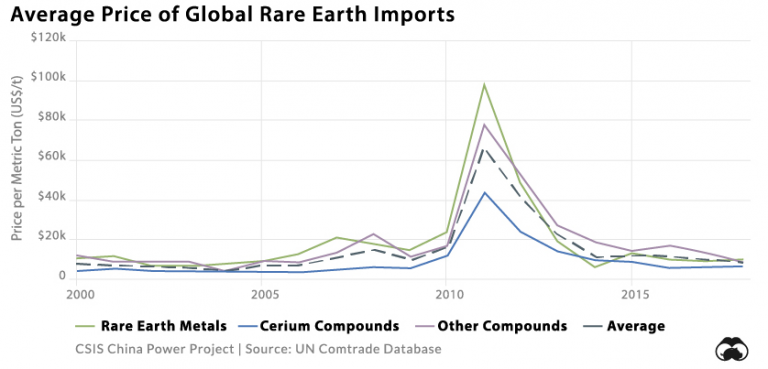
Right. Since the 1980s, the Mountain Pass mine has gone bankrupt and shut down twice. Not because they did anything wrong, but because the prices of rare earths temporarily dropped below their production cost. Here's a general rare earth price graph.[1] It's tough having a business with fixed costs with a 10:1 price variation.
MP Minerals is now getting subsidies from both the U.S. Government and General Motors, both of which want a reliable source of magnets outside China.
There are other sites in the US and Australia which could be developed if it was profitable. (Operating in Greenland, per Trump, is silly. The costs of operating anything big there are very high. No roads, no infrastructure, only a few months a year of ice-free construction time...)
They're totally at the mercy of world rare earth prices, which are manipulated by China. But they now have some cushion from government and GM funcing.
Collapse in MP, the minerals sector in general, and every high growth sector in the market is institutional derisking in the face of massive leverage ($1.4 trillion in margin loans), which has triggered an historic collapse in high beta stocks -- nothing to do with rare earth prices, particularly for MP which has guaranteed price floors.
So,the big players have taken a wrecking ball to minerals by shorting the sector to oblivion, but will have no problem riding the wave back up once the bottom is in...


Everyone says that but I've had the opposite experience, possibly due to my location (near Orchard Rd). Can easily pay $15 to essentially go around the corner.
reply